
Foreword Friday: The Premortem
What Brené Brown and Adam Grant taught me about getting ahead of failure
👋 Hey, I’m Grant. Each week I share lessons from the sales leadership trenches. What’s working, what’s not, and what I wish someone had told me years ago.
In this week’s Stretch VP: Weekly:
Why postmortems are useful but almost always too late
What Brené and Adam say about premortems and why they actually work
How to use them in deal reviews, QBRs, onboarding, and yes, real life
Plus: The one question to ask before anything goes sideways. In sales. In parenting. On the back nine.
Want to work together? I help founders and revenue leaders build and operationalize the systems and structure behind predictable, scalable revenue. Reply to this email or DM me to explore what that could look like.
If you find this valuable, consider sharing it with a fellow sales leader. Not subscribed? Fix that here 👇
The postmortem.
You all know this one: a deal dies, a quarter ends, maybe an onboarding falls apart. We see the slack: “Hey, let’s get a postmortem on the calendar to talk through this one.”
We gather the team, review the tape, maybe listen to some calls. Everybody’s in the room. We ask, “Hey, what went wrong? What could we have done better?”
We’re pretty thorough here, and hopefully we’re honest and take notes, and we learn from these things. No doubt that they are real lessons. I’m a big fan of going over our successes and our stumbles so we can learn and get better.
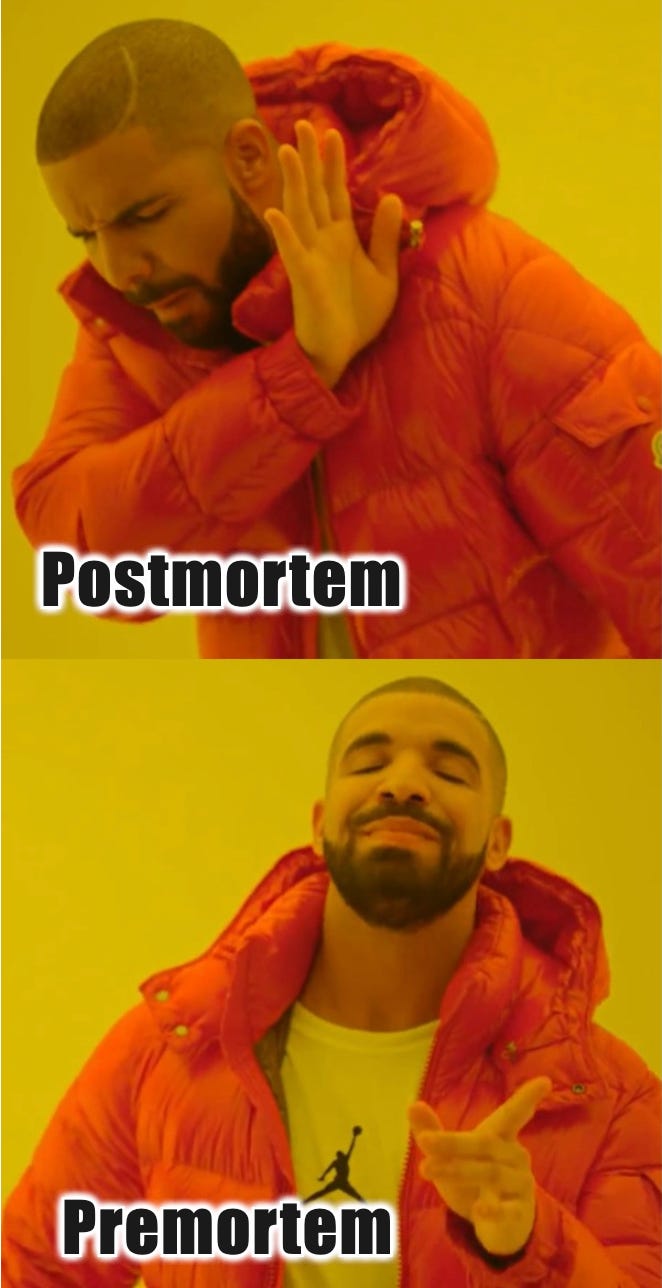
But often the timing is pretty brutal. The deal is just barely gone. we’ve hardly had a chance to get our breath after the quarter-end push, and/or the client already churned. The issue isn’t necessarily doing these. Its in the timing. Hindsight is always 20/20 anyway. But what if we could see that clearly in the future?
Brene’ & Adam peaked my curiosity
As is the case with many of my prior newsletters, I tend to lean on podcasts to share insights and pertinent findings that help me as a leader, or simply as a father and husband.
This week’s Foreword Friday is no different.
If you haven’t found The Curiosity Shop yet, it’s definitely worth you looking into. Brené Brown is one of my favorite authors and leadership voices, and I’ve also gained a lot from the insights of Adam Grant. Well - they had a public argument in 2016 about authenticity and ended up not speaking for something like four years! They’ve now launched a podcast together.
On a recent episode, Brene and Adam introduced me to the concept of a Premortem. They explained that a premortem is imagining a future failure before a project even begins so that you can identify potential risks and obstacles. That approach lets teams address any vulnerabilities in a fairly low-stakes environment before a crisis ever hits.
This isn't new. Psychologist Gary Klein wrote about it in HBR back in 2007. But hearing Brené and Adam apply it to teams and leadership made me think immediately about how it applies to us in sales and us as leaders.
I’ve never done this. Have you?
The Premortem
Essentially, a premortem is when, before you start on something, you get the team together and you say, “Hey, it’s one year from now and this failed. Tell me why.”
Everyone in the room imagines that the project has already failed. They then each write down any possible reasons why it could have gone sideways. Then you get together, you share and discuss.
Apparently, researchers found that this method of mentally transporting to the future increases the ability to accurately forecast risks by 30%.
Hearing them talk about it makes perfect sense. Psychologically, there are reasons why it works. When we think about future situations from an outside perspective, we can often see things more objectively. We’re not defensive or protecting the plan. We’re just asking, “How would this go wrong?”
Comparing that to what I’ve seen in post-mortems, people often try and defend themselves or look smart by having solutions. Again, with hindsight being 20/20, everybody can be an expert.
The Premortem in sales
In thinking about how this applies to us in sales, I started brainstorming where I could use a premortem to better coach for success. Here’s what I came up with:
1. Deal reviews for late-stage pipeline.
Think about it. We’ve all been a part of postmortems for deals that we have lost, but this one may be the most underused if we can do it right.
Let’s say that you have got a deal sitting at a stage 5 or 6 on paper. It looks great: multiple stakeholders, solid discovery. The champion is engaged, and even access to economic buyer. Seems like everybody’s bought in. But before we can commit that deal- run a pre-mortem.
“Let’s say it’s 60 days from now and this deal pushed. Again. Why?”
I bet some of these will come up:
Not multi-threaded
No engagement from the Economic Buyer
Budget was never formally approved
3 WHY’s are weak. Especially the WHY NOW?
2. QBRs
Every QBR I’ve been a part of is almost always weighted heavily looking backward. Here’s what we did, here’s where we sold, where we missed, and here’s our plan to fix it. Maybe there’s a plan or strategy on a slide or two.
But I’m imagining QBRs where we level set on what’s expected of us, our main KPIs and drivers for success. Then we take a premortem approach and ask: “if we don’t hit our number, why?” “What would prevent you from adding $XX to your pipeline?”
I think this helps us get in front of what our team NEEDS to be successful, instead of looking for blame, or pointing fingers on why they didn’t.
3. Onboarding + Customer Success
I know this is not unique to me, but we will often celebrate a closed deal, do a win report, make a proper handoff. Everybody’s excited. Slack channel is updated and off we go.
But what if, before the kickoff call, we ask, “It’s renewal time, and this customer churned. Why?”
We may find that the Champion who helped push this through is already on their way out and we aren’t multi-threaded. Or technical requirements weren’t properly scoped and we set ourselves up to fail. Maybe we underestimated the adoption needed and it never gains traction.
None of these are a surprise in a postmortem. But all of it is fixable before we even get there if we’ve done a proper premortem.
Premortem in real life (as a spouse, parent, and golfer)
Because this is a Foreword Friday edition of Stretch VP: Weekly - I had to throw some non-sales insights I was contemplating on. Just for fun.
1. As a parent
“It’s the end of the semester and you have straight A’s. How did you accomplish that? Or “it’s the end of the semester and you need to take summer school. Why”
“6 months from now after getting your license, the car insurance premium just went up. What happened?”
2. As a Spouse
“I know we’re both excited about our trip to visit Beijing and The Great Wall of China, but you have to reschedule and miss that portion of the trip entirely. Why?” (True story - misjudged the VISA timing 😬)
“A summer full of quotas, business travel, and football practice, and all of a sudden we forget what the other person looks like. How come?”
3. The Golfer
“You are -3 on the back nine, even par for the day and coming home with 3 holes to go. You end up 6 over par for the day. What happened?” (sadly - another true story. Answer: Sand, Sand, More Sand. Wind)
The case for the premortem
I really enjoyed thinking about how I can stay ahead of any obstacles, or anxieties in the future by using a premortem as a tool in our leadership toolbox. Still on the fence? Hear it from the experts:
Gary Klien (Psychologist - wrote about this in Harvard Business Review) says:
"Projects fail at a spectacular rate. One reason is that too many people are reluctant to speak up about their reservations during the all-important planning phase."
Adam Grant says:
"They make people better at seeing around corners, but they also give people the permission to talk about the things that could go wrong that they're afraid to admit."
Brené Brown says the quiet, more introverted, highly analytic people who are:
"Often told they are constantly raining on people's parades." And defensive pessimists who "have learned to self-censor because they're dragging people around with their worrying."
So… there is one question we can lean on to propel us all forward.
"What would have to be true for this to fail?"
Deal reviews. QBRs. Onboarding. Account and Territory planning. Parenting. Relationships and more.
Do the premortem.
Thanks for reading!
If this was helpful, forward it to another sales leader who might need it.
Want to work together? I help founders and revenue leaders build scalable sales systems through Stretch VP. Reply to this email or DM me to explore what that could look like. — Grant 👋
About Stretch VP: Weekly
Lessons from the sales leadership trenches on what works, what breaks, and how to build systems behind scalable revenue.
I’m Grant. This is where I unpack what I’ve learned leading sales teams for the last two decades.
The wins, the scars, and the things I wish someone had told me earlier. Sometimes tactical, sometimes reflective. But always grounded in real leadership and real life strategy.
I also work directly with founders and revenue leaders through Stretch VP when deeper support is needed. If you’re building or leading a sales organization and trying to do it the right way, welcome.